

Mathematics
BackMathematics includes the study of number, geometry, algebra and data handling whilst also developing thinking and problem solving skills. In addition to helping you develop good numeracy skills, studying mathematics, even those topics not immediately applicable to real-world situations, will help you develop your ability to think around a problem and find a creative solution.
Learning Journey
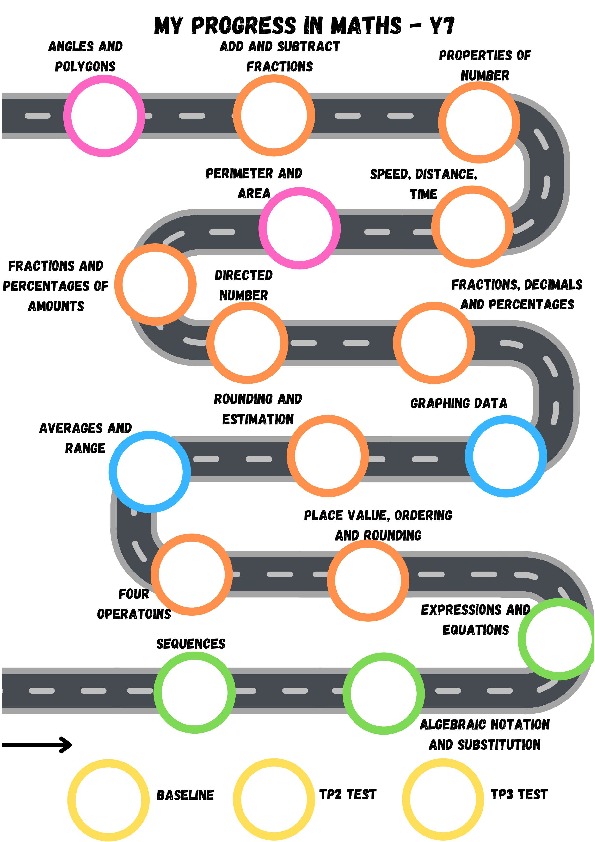
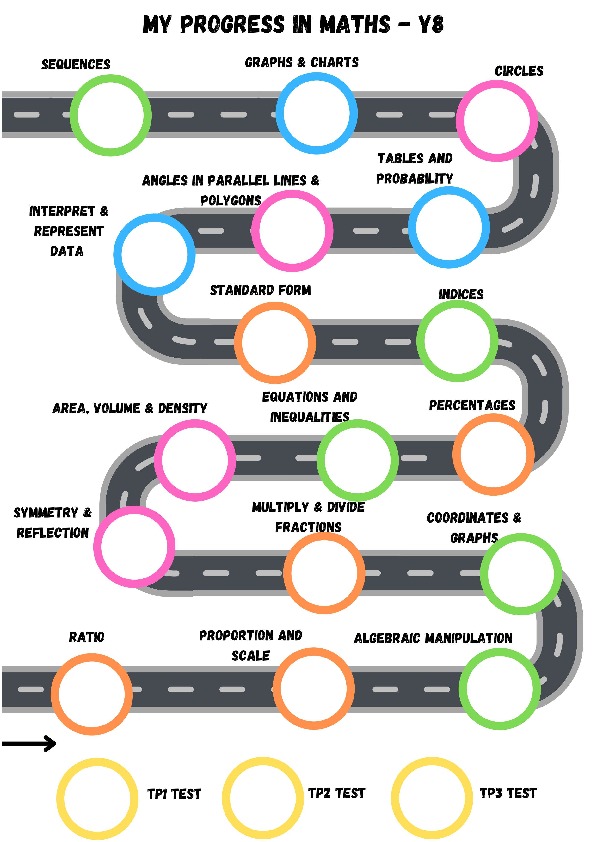
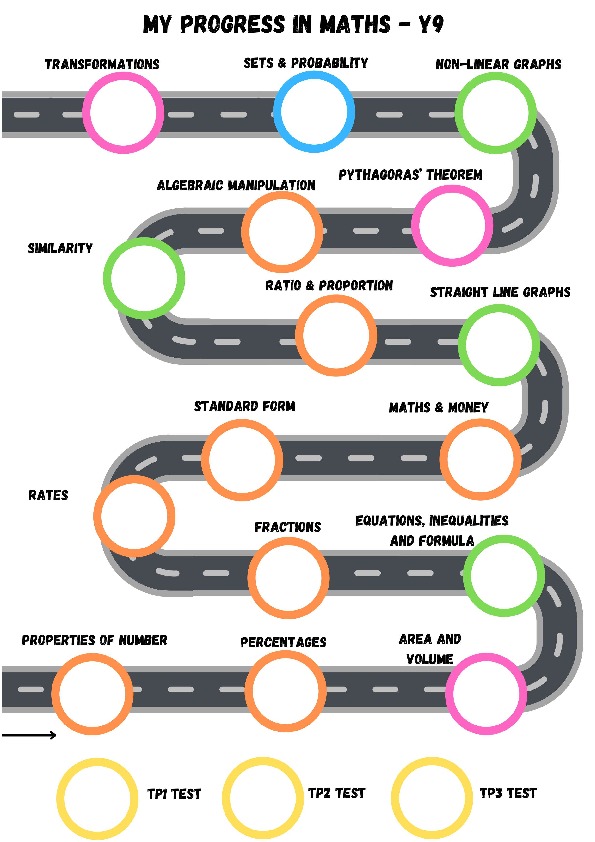
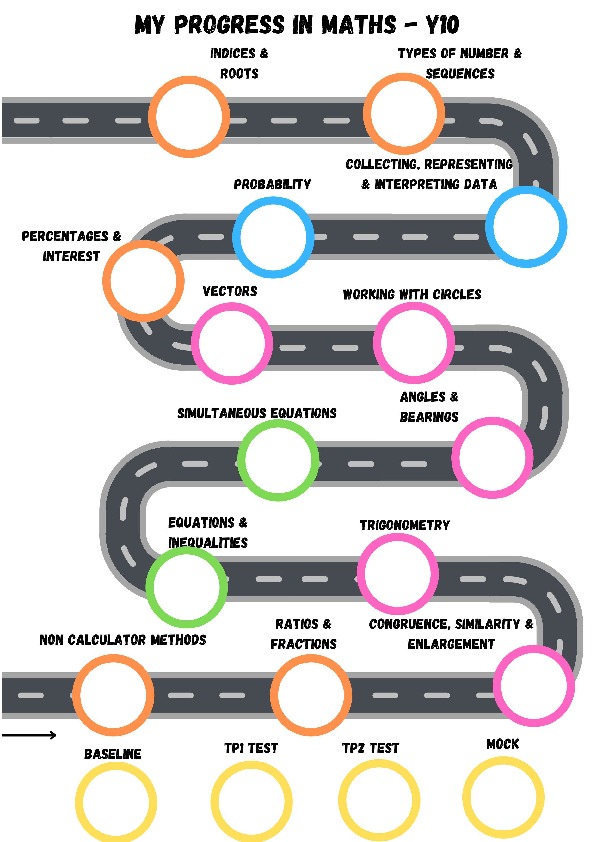
Year 7
At Key Stage 3, all pupils follow the same maths curriculum, which is designed to help them build strong foundations in number, algebra, geometry and statistics. They develop confidence with calculations and learn how to use mathematical language clearly and accurately.
Over the three years, pupils move from learning basic methods to using their maths independently in a range of different situations. They are encouraged to solve problems, explain their thinking, and make connections between different topics. There is a focus on reasoning, spotting patterns, and justifying answers.
As pupils progress through Years 7 to 9, the work becomes more challenging, helping them to deepen their understanding and think more like mathematicians. By the end of Key Stage 3, pupils are well prepared to move on to GCSE Maths with confidence.
| Key Knowledge: | |
|---|---|
| Autumn Term – Number, Algebra and Statistics Pupils develop confidence in using algebraic expressions, equations and sequences. They apply the four operations accurately and use their understanding of rounding, estimation, ordering and comparing numbers. They learn to calculate and interpret different averages and analyse data. As they progress, pupils solve increasingly complex equations, expand algebraic expressions, generalise patterns and work with standard form, applying their mathematical skills to multi-step and unfamiliar problems. Spring Term – Number, Geometry and Algebra Pupils develop confidence in comparing fractions, decimals, percentages and directed numbers. They learn to calculate the areas of two-dimensional shapes using appropriate formulae and build on their algebraic knowledge by applying previously learned skills and plotting graphs. As their understanding develops, pupils make connections between different areas of mathematics, solve increasingly complex problems, and demonstrate independence, efficiency and clear mathematical reasoning. Summer Term – Geometry, Number, Compound Measures and Synoptic Reasoning Pupils develop their understanding of angles, geometric shapes, fractions, and speed, distance and time. They identify and use the properties of triangles and quadrilaterals, solve angle problems, construct geometric figures, and apply formulae to calculate speed, distance and time in real-life contexts. As they progress, pupils apply knowledge from across the curriculum to solve increasingly challenging problems, demonstrating fluency, independence and accurate mathematical reasoning. | |
| Year 7 Assessment Points: Students complete a check in at the end of each unit to reflect on what they have learnt, which includes fluency, reasoning and problem solving. These help students to identify their strengths and weaknesses and their level for each topic to help them prepare for formal assessments throughout the year. The formal assessment points enable students to demonstrate whether they are developing, meeting or at greater depth for the topics in the assessment. The formal assessment points in year 7 are: Baseline assessment – review of prior KS2 knowledge Assessment 1 – Sequences, algebraic notation, expressions and equations, place value, four operations, averages and range rounding and estimation Assessment 2 – Graphing data, fractions, decimals and percentages, fractions and percentages of amounts, directed number, perimeter and area | |
| Key Vocabulary Algebra, expression, equation, substitute, integer, decimal, fraction, percentage, equivalent, simplify, expand, factor, order, compare, reciprocal, product, sum, difference, quotient, negative number, directed number, angle, vertex, parallel, perpendicular, reasoning, justify | Enrichment Maths puzzles and investigations to develop reasoning (e.g. pattern spotting, sequences, logic problems) Practical activities such as measuring, constructing shapes, and using maths in real-life contexts (e.g. budgeting challenges) Online platforms to build confidence with number fluency and algebra basic Junior UKMT challenges or in-school competitions to develop reasoning and justification skills |
Year 8
At Key Stage 3, all pupils follow the same maths curriculum, which is designed to help them build strong foundations in number, algebra, geometry and statistics. They develop confidence with calculations and learn how to use mathematical language clearly and accurately.
Over the three years, pupils move from learning basic methods to using their maths independently in a range of different situations. They are encouraged to solve problems, explain their thinking, and make connections between different topics. There is a focus on reasoning, spotting patterns, and justifying answers.
As pupils progress through Years 7 to 9, the work becomes more challenging, helping them to deepen their understanding and think more like mathematicians. By the end of Key Stage 3, pupils are well prepared to move on to GCSE Maths with confidence.
| Key Knowledge: | |
|---|---|
| Autumn Term - Ratio and Proportional Reasoning, Algebraic Manipulation, Graphs, Fractions and Reflection Pupils develop confidence in using ratio notation and solving problems involving percentages, scale factors, proportional relationships, and the multiplication and division of fractions. They calculate probabilities, plot and analyse graphs, and investigate lines of symmetry and reflections. As their understanding develops, pupils explore direct proportion, non-linear relationships, and analyse and interpret increasingly complex data representations. Spring Term - Algebra, Number, Statistics and Algebra Pupils develop their understanding of equations and inequalities, apply the laws of indices, work with standard form, and calculate percentages, including reverse percentages and repeated percentage change. They use number sense to estimate, check and justify solutions, and collect, present, analyse and interpret data using averages and range to compare data sets and evaluate conclusions. Pupils build on prior learning to calculate the area of two-dimensional shapes and the volume of three-dimensional shapes. As they progress, pupils generalise patterns algebraically and apply their mathematical skills confidently in unfamiliar contexts. Summer Term – Geometry, Algebra and Probability Pupils develop their understanding of geometry, including angles, polygons, circles and area. They apply angle facts involving parallel lines and polygons, calculate the area of a range of shapes, including trapezia and circles, and solve increasingly complex geometric problems. Pupils analyse data, calculate probabilities, and further develop their graphing skills. Throughout the year, they apply their knowledge independently, make connections across different areas of mathematics, and communicate clear mathematical reasoning when solving problems. | |
| Year 8 Assessment Points: Students complete a check in at the end of each unit to reflect on what they have learnt, which includes fluency, reasoning and problem solving. These help students to identify their strengths and weaknesses and their level for each topic to help them prepare for formal assessments throughout the year. The formal assessment points enable students to demonstrate whether they are developing, meeting or at greater depth for the topics in the assessment. The formal assessment points in year 8 are: Assessment 1 – Ratio, proportion and scale, algebraic manipulation, co-ordinates and graphs, multiplying and dividing fractions, symmetry and reflection Assessment 2 – Area, volume and density, equations and inequalities, percentages, indices, standard form, interpret and represent data Assessment 3 – Angles in parallel lines and polygons, tables and probability, circles, graphs and charts, sequences | |
| Key Vocabulary Ratio, scale factor, proportion, percentage change, fraction, multiplicative, Cartesian plane, coordinate, probability, expression, equation, inequality, sequence, index, standard form, angle, polygon, transformation, symmetry, data, mean, median | Enrichment Problem-solving projects involving ratio, proportion and real-life applications (e.g. scale drawings, best buys) Exploration of graphs through digital tools (e.g. Desmos) to deepen understanding of relationships Data investigations where students collect, represent and interpret their own data Junior UKMT challenges or in-school competitions to develop reasoning and justification skills |
Year 9
At Key Stage 3, all pupils follow the same maths curriculum, which is designed to help them build strong foundations in number, algebra, geometry and statistics. They develop confidence with calculations and learn how to use mathematical language clearly and accurately.
Over the three years, pupils move from learning basic methods to using their maths independently in a range of different situations. They are encouraged to solve problems, explain their thinking, and make connections between different topics. There is a focus on reasoning, spotting patterns, and justifying answers.
As pupils progress through Years 7 to 9, the work becomes more challenging, helping them to deepen their understanding and think more like mathematicians. By the end of Key Stage 3, pupils are well prepared to move on to GCSE Maths with confidence.
| Key Knowledge: | |
|---|---|
| Autumn Term – Number, Geometry and Algebra Pupils develop confidence in identifying number patterns, working with standard form and percentages, forming and solving equations, substituting into formulae, and calculating the surface area and volume of prisms. As their understanding develops, they calculate the volumes of cones, pyramids and spheres, model real-life graphs involving inverse proportion, and apply their knowledge of surds in increasingly complex contexts. Spring Term – Number, Algebra, Ratio and Proportion, Geometry and Reasoning Pupils strengthen their understanding of algebraic manipulation and graphing. They solve financial mathematics problems involving profit, loss, interest and compound measures, while developing fluency with rates and proportional relationships. As they progress, pupils apply negative and fractional scale factors and prove results involving similarity and congruence. Summer Term - Algebra, Geometry and Transformations Pupils investigate probability using sample spaces and tree diagrams, draw and interpret quadratic graphs, solve simultaneous equations, and use graphs to model mathematical relationships. They develop their understanding of Pythagoras’ Theorem and transformations. As they progress, pupils apply algebraic reasoning to geometric proofs and extend their knowledge to three-dimensional Pythagoras and trigonometry. | |
| Year 9 Assessment Points: Students complete a check in at the end of each unit to reflect on what they have learnt, which includes fluency, reasoning and problem solving. These help students to identify their strengths and weaknesses and their level for each topic to help them prepare for formal assessments throughout the year. The formal assessment points enable students to demonstrate whether they are developing, meeting or at greater depth for the topics in the assessment. The formal assessment points in year 9 are: Assessment 1 – Properties of number, percentages, area and volume, equations, inequalities and formulae, fractions, ratios and standard form Assessment 2 – Maths and money, straight line graphs, ratio and proportion, construction and congruence, similarity, algebraic manipulation Assessment 3 – Pythagoras’ theorem, non-linear graphs, sets and probability, transformations, simultaneous equations, trigonometry End of Year Assessment – covers all KS3 knowledge | |
| Key Vocabulary Algebra, equation, expression, variable, coefficient, substitute, inequality, gradient, intercept, graph, axis, coordinate, linear, sequence, term, generalise, conjecture, justify, proof, congruence, construction, polygon, angle, parallel, perpendicular, ratio, proportion, percentage, multiplier, scale factor, compound, interpret, analyse, data, distribution, reasoning | Enrichment Extended problem-solving tasks linking algebra, geometry and graphs (e.g. modelling real-life situations) Financial maths projects (e.g. interest, budgeting, comparing deals) to support proportional reasoning Introduction to GCSE-style reasoning and multi-step exam questions Intermediate UKMT challenges or in-school competitions to develop reasoning and justification skills |
Year 10
In Years 10 and 11, you will begin and complete your GCSE Maths course. You will build on what you learnt in Key Stage 3 and develop your understanding of number, algebra, geometry and statistics.
You will become more confident in solving longer, more challenging problems and explaining your thinking clearly. Throughout the two years, you will revisit important topics, deepen your understanding and make links between different areas of maths.
You will also practise exam-style questions and learn how to approach them with confidence, so that you are fully prepared for your GCSE exams, whether you are studying at Foundation or Higher level.
| Key Knowledge: | |
|---|---|
|
Number, Algebra and Geometric reasoning: Autumn Term Foundation: Use non-calculator methods for the four operations, including with decimals and fractions Simplify and use ratios, including sharing quantities and linking to fractions Solve best buy problems Understand and apply congruency in simple geometric contexts Use enlargement with positive scale factors and recognise similarity Establish a pair of triangles are similar Calculate sides in right angles triangles using Pythagoras Apply basic trigonometry (SOHCAHTOA) to find missing sides in right-angled triangles Represent and solve linear equations and inequalities and show solutions on number lines Higher: Understand rational and irrational numbers including recurring decimals Calculate using bounds Solve complex ratio and fraction problems, including multi-step proportional reasoning Use similarity and enlargement with fractional and negative scale factors Prove and apply congruency using formal criteria (SSS, SAS, ASA, RHS) Explore areas and volumes of similar shapes Apply trigonometry to solve problems, including in 3D contexts Apply the sine and cosine rule to find missing lengths and angles Represent and solve linear and quadratic equations and inequalities, including graphical solutions Interpret regions defined by inequalities and connect algebraic and graphical representations
Algebra and Geometric reasoning: Spring term Foundation: Solve pairs of simultaneous equations (linear) using substitution or elimination Use bearings measured clockwise from north and solve problems in context Calculate angles in geometric figures, including polygons and around parallel lines Calculate circumference and area of circles and use in problem-solving Identify and use basic circle properties Calculator arc length and sector area Understand and calculate the volume and surface area of 3D shapes Represent vectors and describe simple vector movements Perform basic vector calculations (addition and subtraction) Higher: Solve simultaneous equations including linear–quadratic systems Solve problems involving bearings and scale diagrams using sine and cosine rules Apply geometric reasoning to complex angle problems including proofs Use circle theorems (e.g. alternate segment, cyclic quadrilaterals) Solve problems involving arcs, sectors and circle geometry Use vectors algebraically and solve geometric problems with vectors Construct and prove results using vector methods
Summer Term: Geometry, Statistics and Number Reasoning Foundation: Calculate percentage increase/decrease and simple and compound interest Solve probability problems using lists, tables and simple tree diagrams Collect, represent and interpret data using charts and averages including frequency polygons, scatter diagrams and pie charts Calculate averages from a table Understand types of numbers including primes, factors and multiples Generate and find the nth term of a linear sequences Use index notation for positive integer powers and apply addition and subtraction rules Calculate and simplify expressions involving roots (including square roots) Higher: Solve problems involving growth and decay Understand iterative processes Conditional probability in two way tables and venn diagrams Interpret and analyse data, including cumulative frequency, box plots and histograms Generate and use algebraic rules for sequences, including quadratic sequences and surds Apply index laws including fractional and negative powers Simplify surds and solve problems involving indices and roots |
|
|
Assessment Points Students complete a check in at the end of each unit to reflect on what they have learnt, which includes fluency, reasoning and problem solving. This will be either foundation or higher depending on their current tier. These help students to identify their strengths and weaknesses and their level for each topic to help them prepare for formal assessments throughout the year. The formal assessment points enable students to demonstrate the GCSE grade they are working at for the topics in the assessment. The formal assessment points in year 10 are: Baseline assessment – review of prior KS3 knowledge Assessment 1 – Non-calculator methods, ratio and fractions Assessment 2 – Congruence, similarity and enlargement, trigonometry, equations and inequalities, simultaneous equations End of Year assessment – GCSE papers covering all year 10 content |
|
|
Key Vocabulary Non-calculator methods, ratio, proportion, fraction, scale factor, congruence, similarity, enlargement, trigonometry, sine, cosine, tangent, equation, inequality, simultaneous equations, angle, bearing, circle, radius, diameter, circumference, vector, percentage, interest, probability, outcome, frequency, data, sequence, term, index, root, reasoning. |
Enrichment Regular exposure to GCSE exam-style problems beyond the classroom, including higher-tier challenge questions Use of past papers and exam workshops focusing on strategy and problem solving STEM-based enrichment such as applying trigonometry, vectors and algebra in real-world contexts (e.g. engineering links) Maths revision clubs, peer tutoring, and independent study Intermediate UKMT challenges to develop reasoning and justification skills. |
Year 11
In Years 10 and 11, you will begin and complete your GCSE Maths course. You will build on what you learnt in Key Stage 3 and develop your understanding of number, algebra, geometry and statistics.
You will become more confident in solving longer, more challenging problems and explaining your thinking clearly. Throughout the two years, you will revisit important topics, deepen your understanding and make links between different areas of maths.
You will also practise exam-style questions and learn how to approach them with confidence, so that you are fully prepared for your GCSE exams, whether you are studying at Foundation or Higher level.
| Key Knowledge: | |
|---|---|
|
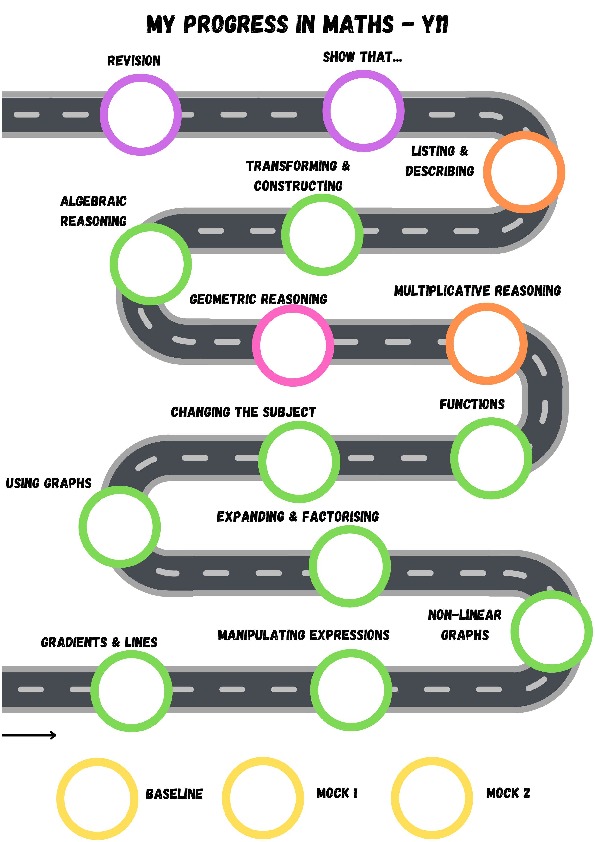
Autumn Term: Algebra and Graphical Reasoning Foundation: Find gradients from graphs and between two coordinates Identify and sketch basic non-linear graphs (quadratic, cubic) Rearrange simple linear expressions Recognise key features of graphs (intercepts, turning points) Use graphs to find approximate solutions Expand single and double brackets Factorise expressions into brackets including quadratics Change the subject of simple formulae Solve equations involving brackets Higher: Calculate gradients including parallel and perpendicular lines Sketch and interpret quadratic, cubic, reciprocal graphs Expand and simplify expressions with multiple terms Recognise transformations of graphs Use algebraic manipulation to prepare for solving equations Factorise quadratics (including where a ≠ 1) Use graphs to solve equations (including quadratics) Interpret gradient and area under graphs Rearrange complex formulae (subject in denominator, brackets) Link algebraic solutions to graphical representations
Spring Term: Functions, Multiplicative and Algebraic Reasoning Foundation: Understand and use function notation (e.g. f(x)) Substitute values into functions Use ratio in real-life contexts Use basic Pythagoras’ Theorem Solve linear equations (including with brackets) Form expressions and equations from word problems Recognise and describe transformations (reflection, rotation, translation) Plot and describe transformations on grids Construct triangles using given measurements Identify symmetry in shapes Higher: Use composite functions and inverse functions Solve problems involving direct and inverse proportion Apply ratio and proportion in multi-step problems Solve angle problems including algebraic reasoning Solve simultaneous equations (algebraically and graphically) Solve quadratic equations (factorising and formula where needed) Use algebra in complex problem-solving contexts Describe and perform combined transformations Construct loci and interpret regions Solve geometric problems using reasoning and proof |
|
|
Assessment Points Students complete a check in at the end of each unit to reflect on what they have learnt, which includes fluency, reasoning and problem solving. This will be either foundation or higher depending on their current tier. These help students to identify their strengths and weaknesses and their level for each topic to help them prepare for formal assessments throughout the year. The formal assessment points enable students to demonstrate the GCSE grade they are currently working at. The formal assessment points in year 11 are: Baseline assessment – review of year 10 content Mock set 1 – GCSE papers covering all content Mock set 2 – GCSE papers covering all content |
|
|
Key Vocabulary Gradient, line, graph, expression, factorise, expand, non-linear, function, formula, subject, multiplicative, proportion, geometric reasoning, algebraic reasoning, transform, construct, proof, justify, describe, sequence, revision, exam technique. |
Enrichment Structured revision programmes including walking-talking mocks and targeted intervention sessions Completion and analysis of past GCSE papers to refine exam technique and timing High-level problem-solving practice (especially for Higher tier students) focusing on reasoning and proof Independent revision resources, including checklists, topic-based practice and self-quizzing strategies. Intermediate UKMT challenges to develop reasoning and justification skills |
| Subject Documents |
|---|
| Maths GCSE Foundation Revision Tasks |
| Maths GCSE Higher Revision Tasks |